The published roadmap
What the energy column concedes
The roadmap's most quoted application is solar — extending a farm's generating hours from orbit. Reflect Orbital's own table marks that service Testing in 2026, 2027 and 2028. The first year it claims a delivered figure is 2030, and the figure is a 1% improvement in capacity factor.
The company's own footnote narrows it further: “Assuming a typically overbuilt solar farm, production increase for Southern CA is estimated to be 0.75% and Germany is expected to be 1.4%.” So the headline energy case, four years from now and with five thousand satellites in orbit, is under one percent in California.
That is worth stating plainly because the solar-farm application is the one that appears in most coverage. On the arithmetic, a 1 MW farm illuminated for 3.5 minutes receives about 0.058 MWh — roughly $2.92 of electricity at $50/MWh, against a service priced around $5,000 per mirror-hour. The company is not claiming otherwise; its roadmap simply places a usable energy product in the 2030s.
The lighting ladder, against things you can judge
Lux figures are hard to intuit, so the bars below place Reflect Orbital's claims beside familiar light levels. The pale bars are references, not company claims. The scale is logarithmic — each step is a tenfold increase — because the range spans five orders of magnitude.
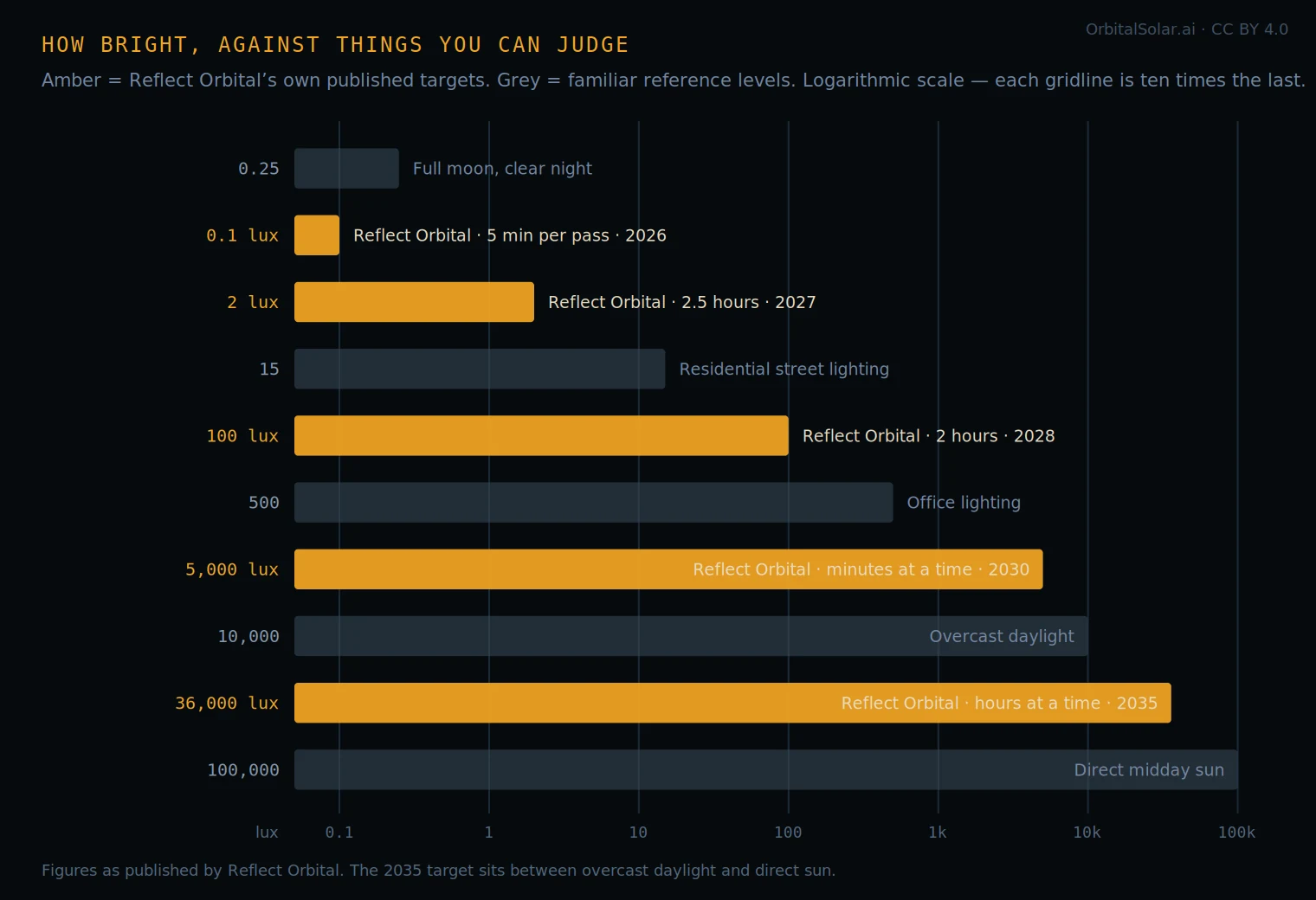
Two things follow from the scale. The 2026 demonstration at 0.1 lux is dimmer than a full moon, which is about 0.25 lux — a real but modest effect, and consistent with what a single 18-metre reflector can deliver. And the 2035 figure of 36,000 lux, which the company compares to daylight, is closer to bright shade: direct midday sun is roughly 100,000 lux.
One discrepancy on their own page
Reflect Orbital's homepage gives the 2027 constellation as 36 satellites in one block and 38 in another, on the same page. We have used 36, the figure in the primary roadmap graphic. It is a small thing, but worth noting for anyone citing the number.
What the company commits to on dark skies
Alongside the roadmap, Reflect Orbital publishes commitments worth recording accurately: it says it maintains “strict exclusion zones for astronomy and sensitive environments”, that light is delivered only where specifically requested and approved by local authorities, and that satellite positions will be shared in advance so that observatories can plan around the service. It also states the light cannot be concentrated beyond natural sunlight irradiance and is not bright enough to start fires or harm eyes.
Those undertakings are the company's own and are not independently verified. They sit against formal objections filed with the FCC by the Royal Astronomical Society, the American Astronomical Society and DarkSky International, and the FCC's own finding that light pollution and telescope interference fall outside its authority to regulate. Both are true at once, and any honest account of the roadmap carries both.